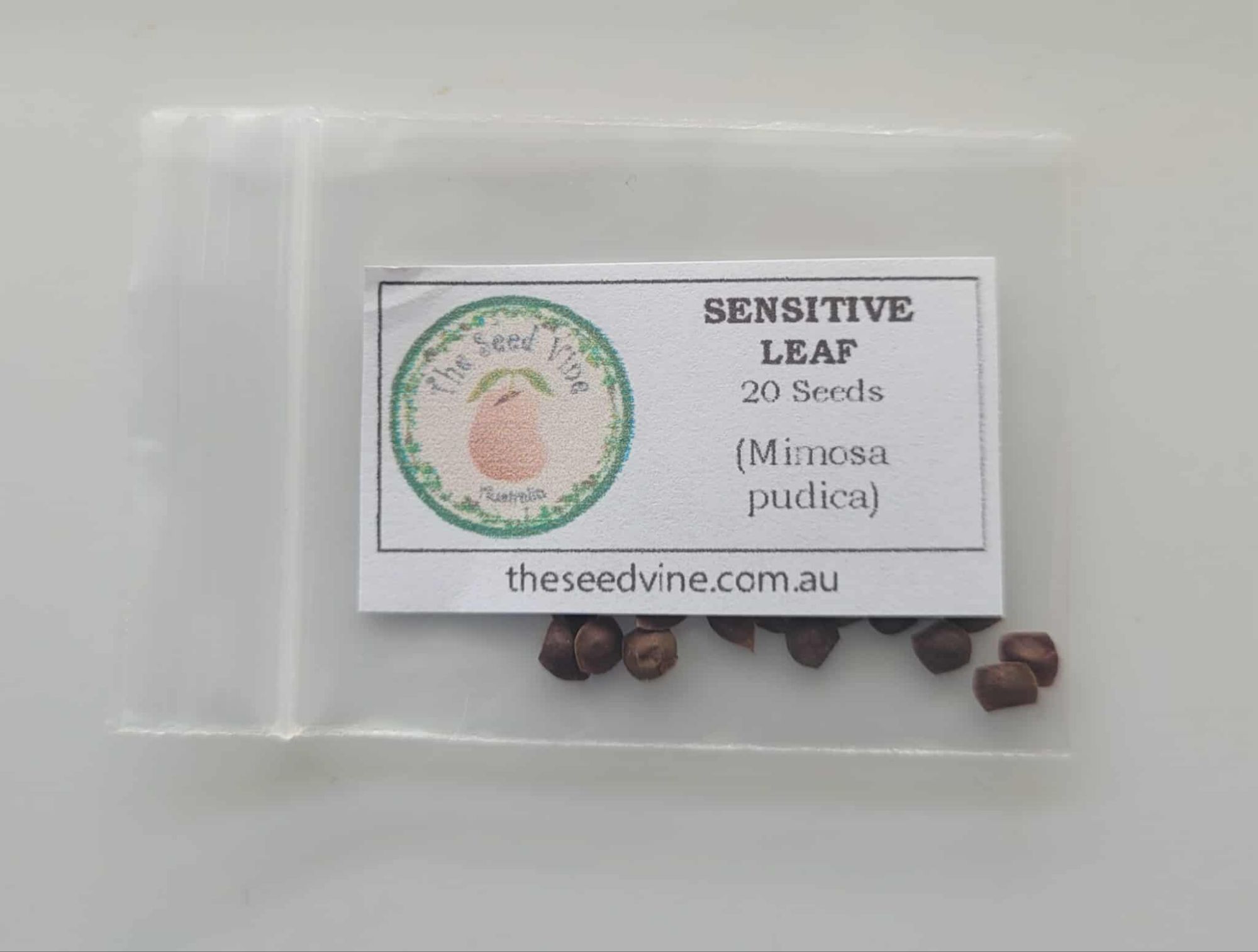
Mimosa pudica (Sensitive Plant) is a creeping flowering plant that is native to the tropical regions of South and Central America as well as islands throughout the Caribbean. Sensitive Leaf is naturalised in most tropical climates and is well known for its leaves that close when touched. It is also commonly grown in closed mining sites to improve soil quality and as an ornamental.
Suitable for Sub-Tropical and Tropical climates.
Mimosa pudica can become highly invasive in warm climates but is also viewed as a valuable plant for its nitrogen fixing and ability to repair poor soils. Often it is also seen as the entertainer of the plant world with its rapid leaf movement when touched.
Mimosa pudica is also called Sleepy Grass, Humble Plant, Shameplant, Touch Me Not, Action Plant and Touch and Die. As a child growing up in Far North Queensland, the Sensitive Leaf was common knowledge, a bit of fun, but also contained little prickles that curbed my wandering bare feet.
Tourists were highly amused, traditional herbalists in the area were drinking the leaves as part of herbal teas and those with prized lawns were often seen digging them out with shovels.
Growth
Mimosa pudica is a fast growing, creeping plant that grows to only 30cm (1 foot) in height but can spread up to 150cm (5 feet) wide. Sensitive Leaf thrives in most soils but requires constant warm temperatures of at least 13°C/55°F and does not tolerate frost.
In these conditions, Sensitive Leaf plants can become highly invasive so it is recommended to either grow them in containers or to prune the flowers prior to blooming. They can be grown indoors in temperate climates but will not often receive the required sunlight of 8 hours per day to induce flowering.
The action-packed leaves are bipinnately compound with one or two pinnae pairs and up to 26 leaflets per pinna. Stems are strong and erect while the plants are young but become creepers and spread with age. Flowering can occur within 3-4 months of seed germination and can be blooms of pink or purple. Each bloom lasts less than 24 hours and is usually completely dead within two days.
Note: Germination instructions can be found in the ‘Germination Instructions Tab’ below. Upon purchase you will receive these detailed instructions via email so that you have a permanent record.
FAMILY:
Fabaceae
CLIMATE:
Temperate (Indoors), Sub Tropical & Tropical
TEMPERATURE RANGE:
13 to 35°C / 55 to 95°F
SOIL TYPE:
Prefers a well-draining soil.
LOCATION:
Full Sun, does not flower in shade.
HEIGHT:
Up to 30cm (1 foot)
WIDTH:
Up to 150cm (5 feet)
pH:
6.0-7.5
GROWTH TYPE:
Perennial. Annual in cold temperatures.
WATER REQUIREMENTS:
Medium
POLLINATION:
Self-fertile but assisted by Bees and Butterflies.
MATURITY:
3-4 months
GERMINATION RATES:
80-90%
GERMINATION TIME:
21-28 days
GERMINATION DIFFICULTY:
Easy
SEEDS PER GRAM:
Approximately 100 seeds
MEDICINAL QUALITIES:
Yes
WEED POTENTIAL:
Yes
EDIBLE:
No
SEED STORAGE & VIABILITY:
Cold Storage at 4°C (Fridge) for 2 years.
FACTS ABOUT MIMOSA PUDICA (Sensitive Leaf)
As a species, Mimosa pudica has similarities with the Venus Flytrap as both have hairs that are hypersensitive to the touch. The rapid action movement that occurs upon touch is similar also to the Dancing Plant, though not as fast.
Some studies have been conducted to ascertain whether the Sensitive Leaf plant can retain memories. One particular study concluded that plants could remember some actions for up to 28 days.
The leaves of the Sensitive Leaf close at night time and reopen when the light returns in the morning.
Another study in Thailand found that Mimosa pudica was one of four plant species that could extract arsenic from the soil surrounding old tin mines. Other studies have found that the plants can also extract heavy metals such as copper, lead, tin, and zinc from polluted soils.
The Sensitive Leaf is also used traditionally in herbal medicine, in particular, the roots and leaves have been used in remedies for ulcers, wounds and snake bites. Herbal teas made from the leaves are said to assist with anxiety and to boost the immune system.
The botanical epithet, pudica is translated from Latin to mean shame, bashful or shrinking which alludes to its shrinking reaction to contact.