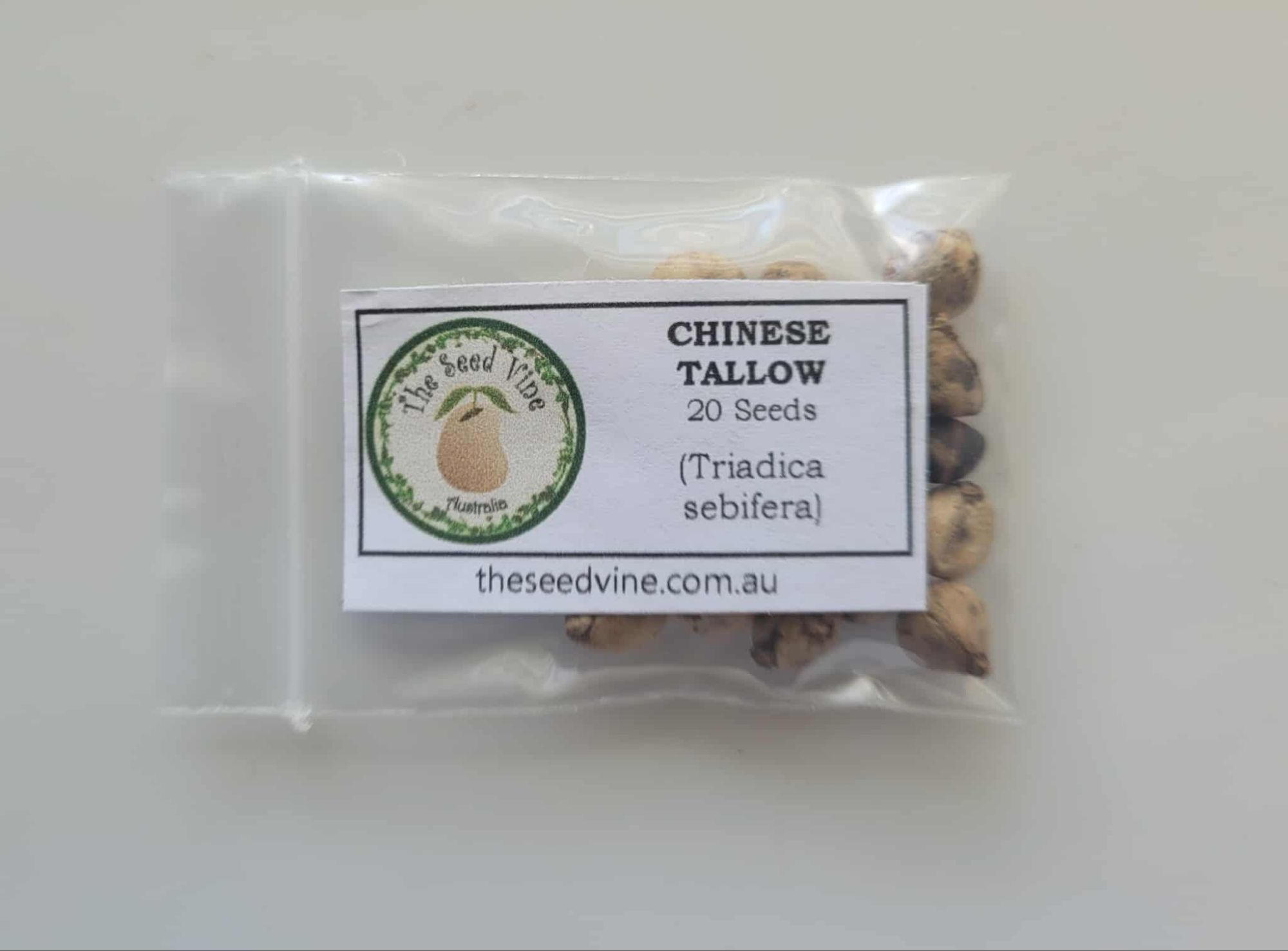
Triadica sebifera (Chinese Tallow) is a fast-growing, deciduous tree that is native to China, Japan and throughout the Himalayas. Chinese Tallow is an ornamental with heart-shaped leaves that can produce red, gold and purple leaves at the same time during Autumn. It is a popular bonsai variety and also produces an excellent nectar that is prized by beekeepers around the world.
Suitable for Temperate, Dry and Sub-Tropical Climates.
Triadica sebifera has many common names that include Candleberry Tree, Popcorn Tree, Chicken Tree, Florida Aspen and the Vegetable Tallow. In nurseries it can often have the botanical name Sapium sebiferum
The Chinese Tallow has uses in biodiesel fuel, as a lard substitute, a laxative, a wood to make furniture and the seeds can be used to make soap. It is also a common choice for counteracting soil erosion.
There is a catch. Chinese Tallow trees are not only fast-growing but it can rapidly spread and become highly invasive. The leaves and sap are also toxic, not only to humans but can also harm other nearby plants.
For more varieties that are ideal for bonsai growing click here.
Growth
Triadica sebifera is a beautiful deciduous tree that grows to a humble 9 metres (29 feet) by 5 metres (16 feet) at a rapid rate. In ideal temperate conditions, Chinese Tallow can start flowering and producing seeds within just 3 years.
The simple, deciduous leaves of this tree are alternate, heart-shaped and often resembles the Sacred Fig (Ficus religiosa) with its extended tail. During Spring and Summer the leaves are bright green but become a range of colours in Autumn that include yellows, oranges, purples and reds.
Chinese Tallow produces male and female flowers on the same tree that compared to their leaves are a bland green or white. Flowers typically occur from mid-Spring to early Summer eventually producing seeds in the Autumn.
Although most will reach maturity in 5-8 years, the ideal conditions can sometimes see flowering on trees as young as 3 years. The Chinese Tallow is a beautiful tree but should be grown with plans of containment as they can become highly invasive.
Note: Germination instructions can be found in the ‘Germination Instructions Tab’ below. Upon purchase you will receive these detailed instructions via email so that you have a permanent record.
FAMILY:
Euphorbiaceae
CLIMATE:
Cold, Temperate, Dry and Sub-Tropical Climates
TEMPERATURE RANGE:
-10 to 35°C / 14 to 95°F
SOIL TYPE:
Grows in most soils, including salty or boggy.
LOCATION:
Full Sun or Part-Sun.
HEIGHT:
Up to 9 metres (29 feet)
WIDTH:
Up to 5 metres (16 feet)
pH:
5.5-7.5
GROWTH TYPE:
Deciduous
WATER REQUIREMENTS:
Low
POLLINATION:
Bees and Insects
MATURITY:
3-8 Years
GERMINATION RATES:
75-90%
GERMINATION TIME:
3-4 weeks at temperatures between 20 and 25°C / 68 to 77°F
GERMINATION DIFFICULTY:
Easy
SEEDS PER GRAM:
6
MEDICINAL QUALITIES:
Yes
WEED POTENTIAL:
Yes
EDIBLE:
No
SEED STORGE & VIABILITY:
Cold Storage at 4°C (Fridge) up to 2-3 years.
FACTS ABOUT TRIADICA SEBIFERA (Chinese Tallow)
Triadica sebifera seeds can be used as a lard substitute, in cacao butter, used to make soap and contains between 40-50% fat. Pure tallow fat is commercially traded under the name Pi-vu. The wax of Tallow tree seeds is said to repair hair and can change grey hair to black.
Chinese Tallow trees are the third most productive plants in biodiesel behind algae and oil palm.
Traditional medicine has been known to use Tallow leaves to treat boils, assist with constipation, skin ulcers and snake bites but are in modern medicine considered to be toxic to humans.
The tree was said to have been introduced to the United States by Benjamin Franklin around October 1772, but since then has become a highly debated invasive species. Though many state officials attempt to find ways to curb their spread, they are highly sought after by beekeepers. Many beekeepers are said to travel with their bees to North and South Carolina during the flowering season.
Due to the plants high invasive characteristics it is now illegal to import or sell the species within the European Union.